About
My story
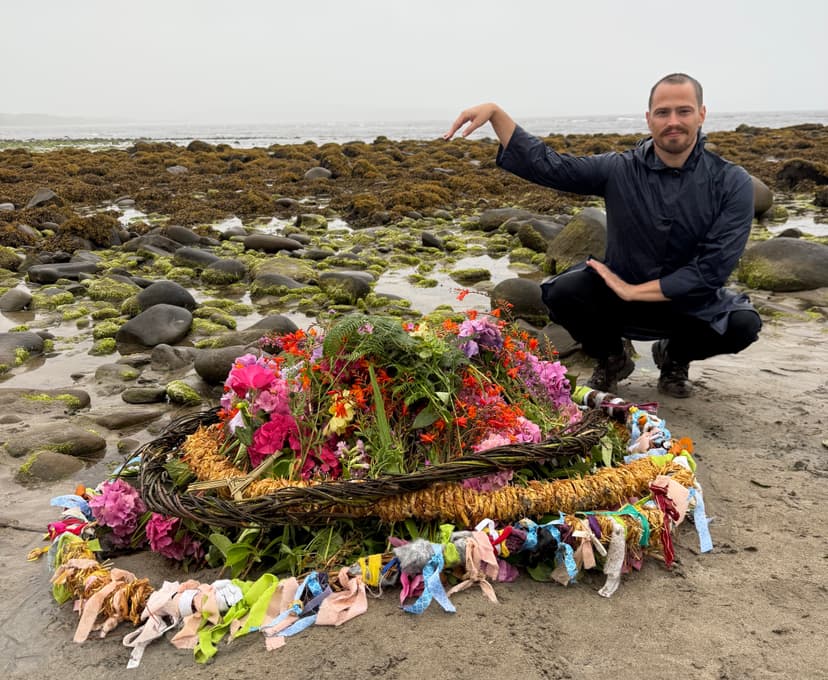
I am Russell Patrick Brown, American Bashaldo Gypsy dancer, harper, embodied engineer, writer, and the innovator of Gypsy Dance as a recognized contemporary artistic framework. Born in Cleveland, Ohio into a family with an unbroken traveling tradition stretching into the Appalachian Mountains and down into Georgia, I have spent my life continuing what was given to me: tradition, fortune-telling, embodied engineering, and the visceral knowledge of how to move through time.
My artistic lineage is rooted in both profound grief and radical survival. After my great-aunt Loretta tragically died at just 26 due to congenital conditions that Western doctors consistently fail to properly diagnose for many Roma, my grandfather made a definitive shift. He left traditional Bashaldo music behind, transitioning to Gypsy jazz, standards, and the intimate, protective space of music in the kitchen with his accordion. He had a special song for everyone who entered that kitchen; for my mother, it was her namesake, Johnny Mercer's "Laura."
Following his lead, my mother and father hid within the American folk movement, continuing our step traditions by joining the Irish-American community in the East and West Side clubs of Cleveland, threading together deep, hidden Romani histories of percussive step dance. For me, intense musical training on spoons, saxophone, oboe, voice, guitar, and piano began at age five, following two formative years of early dance.
When I moved to New York City at 22, I took up Irish step dance again under Donny Golden, carrying my steps to the piers of Queens, Manhattan, and Brooklyn. There, I embedded myself in the historic lineage of NYC pier-dancing, trading steps with African-American and queer/trans BIPOC Vogue house communities in 2013—an intersectional somatic exchange I later documented in my chapter on Choreonavigation in mairitme dance in the "aquatic assemblages" of NYC and the Anglophone colonial world. I became a fixture in the New York cabaret and nightlife scene, playing harp and dancing for Manfred Thierry Mugler and Joey Arias, performing at Susanne Bartsch's iconic parties, collaborating with the historic theater company Mabou Mines, and banging the floors of gritty underground venues that have since been erased by brutal real estate development.
While in New York, I pursued Irish and Irish-American Studies at New York University, learning from pioneers in Atlantic World history and performance, while also studying within the transformative Performance Studies department, an experience that completely redefined my relationship to the body and politics. It was during this time that the legendary Mick Moloney recognized the deeper currents in my work and gave me the pivotal advice that altered my path: to take my research across the Atlantic and pursue my PhD at the University of Limerick.
Following Mick's advice, I carried these steps to Ireland over the next twenty years, appearing in productions in Dublin and for RTÉ and the BBC. I performed what I then called "Step&Vogue" in the nightclubs of Galway and Dublin (including The George), taught ballroom and Vogue movement practices to neurodivergent actors at Galway's Blue Teapot Theatre Company, and eventually completed my PhD at the Irish World Academy of Music and Dance, University of Limerick.
Eight years ago, I entered the formal Romani rights movement. For a time, I chose to step away from the stereotype of the "dancing Gypsy" and pivoted into software engineering, leading technical teams for America's largest media publishers. But during the pandemic, the landscape shifted violently. Developers began targeting my historic home on Gay Street in Greenwich Village, systematically destroying the rich Romani and African-American history embedded there. After large-scale community protests, a New York Times article, and a feature in Gothamist, I was effectively driven from my home. I fled back to Ireland, where I had shared two new works, AngelAI (2023) and Who is Allowed to Fall (2025), viewing the stage not as mere entertainment, but as a living ritual of survival, identity and community. When my post-PhD application to remain was ultimately unsuccessful, I found refuge in Spain.
Here, in Spain, I have rebuilt my life from the ground up using the only true asset I have left: Gypsy Dance. Today, I know that I am a dancer, a harper, a fortune teller, and an embodied engineer. These identities are not separate; they are my futurism, my present, and my past.
As the pioneer of Gypsy Dance in the contemporary world, I am not staging a revival of a fixed tradition. What Roma and Sinti carried across centuries and oceans was never one style; it was a method of how impact, rhythm, and percussive weight move through a body shaped by displacement and survival. That method didn't end when the music changed. It moved into diverse ethnic and jazz clubs in Cleveland, into piers and cabarets in New York, into a body three generations and an ocean removed from where it started. It is still moving. Gypsy Dance is what that method looks like now: the hard impact of the stomp and the vulnerability of the softness as a declaration of sovereignty, carried, not invented, and mine to continue.
Research & Academic Inquiry
My work bridges somatic movement history, physical performance, and technological architecture. I hold a PhD in Arts Practice from the Irish World Academy of Music and Dance, University of Limerick. This was a profoundly de-colonial doctorate that instead of privileging western academic objectivity, it centered the expert knoweldge of artists, first person narratives and embodied experience.
My doctoral dissertation, Intimate Violence: Feeling Impact in Irish Step Dance, examined percussive dance, embodied knowledge, and the hidden Romani and Irish histories carried within rhythmic traditions. Accepted without corrections, this academic work serves as the theoretical and historical foundation for Gypsy Dance, mapping how oppressed bodies codify memory, survive systemic trauma, and pass down generational resilience through rhythm.
I have forthcoming publications with Routledge in 2027, and more to be announced soon.
Education: Moving Through Gypsy Fires
To translate PhD-vetted dance impact literacy and ancestral survival wisdom into practical tools for modern daily life, I write and teach on my Substack platform, Gypsy Fires. I provide guided, embodied education designed specifically for times when the ground beneath us is shaking.
- The Timedancing Lab: An exploration of hyperchronicity—the experience within dance tradition when we can feel all times in this time, and this time in all times. The Lab is a historical, theoretical, and psychic archive built to help us find a way out through rhythm, cadence, and repetition.
- The Micro-Dance School: Threads together broken global percussive dance traditions born from survival. It's a physical somatic toolkit designed to break corporate fatigue and colonial mind-fracking, allowing you to reclaim your body directly at your desk. This space offers instant access to premium streamable audio loops, rhythmic tapping tracks, movement frameworks, and guided meditations.
Code & Choreography: The Architecture of Organizing Time
Beyond the stage, the studio, and the archives, I bring this exact same somatic precision to technology. I previously served as an Engineering Manager and Technical Lead for major publications, including Fortune Media and People, Inc. (formerly Dotdash Meredith).
For me, these worlds are not separate: Code is choreography, and choreography is code. I approach performance engineering—optimizing systems for speed, latency, and efficiency—as simply another medium for the art of organizing time.
Spiritual Embodiment, Lineage & Sound
For fifteen years, I have worked at the intersection of spiritual embodiment, vibrational medicine and ritual, building on the traditions my own family has carried for generations. As a long-time resident practitioner, harper, and educator within the historic community of Lily Dale, New York, I have served seeker communities of all ages—using the resonant strings of the Irish harp as a physical channel for intuitive guidance, memory, and healing.
My approach to spiritual embodiment is grounded in rigorous, ancestral discipline. Mentored directly in the British spiritualist tradition by the legendary Mavis Pittilla, I refuse to treat spiritual work as an abstract mystery. Instead, I approach it as a concrete, physical practice—using sound, rhythm, and lineage to help others anchor themselves, process trauma, and remember who they are. Mavis prophesized when I first met her that I would be a great voice for Spirit, and every day I work to honor her legacy and blessing.
Languages
English (Fluent) · Spanish (Advanced) · Irish (Advanced Beginner) · Romungró (Beginner)
Press
- 2025 — “Rediscovering the Romani identity.” The Clare Champion.
- 2025 — “UL graduate embraces identity and heals trauma through dance.” Live95.
- 2025 — “I am whole: Journey in dance helped UL graduate embrace identity and heal trauma.” University of Limerick News.
- 2025 — “Journey in dance helped UL graduate embrace identity.” The Clare Herald.
- 2023 — “Holdout tenant in $1,500 West Village apartment fears demolition of historic townhouse.” Gothamist.
- 2020 — “Fortune adopts paywall in major redesign of site, magazine.” New York Post.
- 2019 — “Growing Up Roma in America: Russell's Story.” Roma Peoples Project.
- 2012 — “Russell Patrick Brown.” Time Out New York.
- 2011 — “In Focus: artist, musician and dancer — Russell Patrick Brown.” IrishCentral.
- 2009 — “A hot front.” New York Post.